
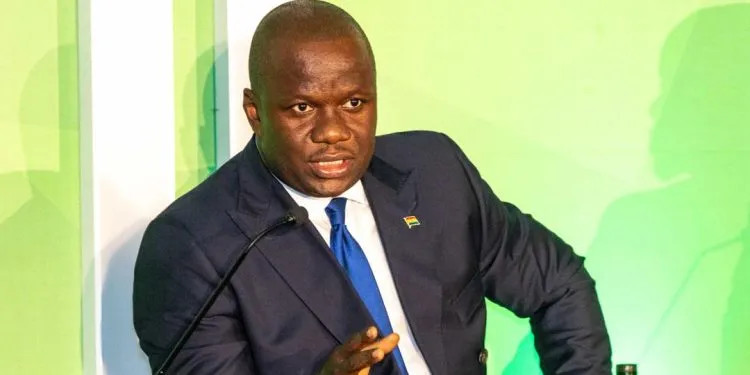
Member of Parliament for the Damango Constituency in the Savanna Region, Honourable Samuel Abdulai Jinapor has urged members of the House of parliament to set aside partisanship and treat free speech as a national concern, arguing that successive governments have all grappled with the issue of press freedom and freedom of speech.
The MP said the Minority Leader’s recent statement on same issue rose above party lines to raise the matter for national interrogation.
The Immediate past Lands and Natural Resources Minister contrasted that approach with what he described as the Minister for Communication’s decision to take a partisan path during debate on the floor.
“With the greatest of respect to the Honourable Minister given that he’s the Minister responsible for communication, one would have most respectfully expected that he will approach this subject in a manner that the minority did.
Be non-partisan and let us interrogate the issue of press freedom and free speech,” the MP told the Speaker.
He said examples cited by the Minister from President Akufo-Addo’s tenure still require scrutiny.
He also referenced issues raised by the Minority this month that were reported by Al Jazeera, noting Parliament would continue to deal with the matter.
The MP traced efforts to expand freedoms across administrations.
He said President Kufuor repealed the criminal libel law in 2001, President Mills made several attempts to broaden free speech and press freedom, President Mahama continued that work in his first term, President Akufo-Addo “did his bit,” and President Mahama is now “doing his bit.”
He added that not everything should be reduced to partisanship.
He then drew a sharp line between press freedom and freedom of speech. “You may have a situation where the press is free to do its work. That is press freedom,” he said.
“There is a distinction; it’s like day and night between press freedom and freedom of speech, and what the minority leaders sought to deal with was freedom of speech.”
To illustrate, the MP cited a 2010 incident involving a planned burning of a holy book in the United States.
He said the US President did not arrest the individual but instead invited and persuaded him not to proceed, given the potential consequences for American foreign policy and interests.
He argued that abuse of free speech should typically be addressed through civil defamation, not criminal arrests.
Closing with a quote from the Minority’s statement, the MP said: “Democracy belongs to all of us.
It is not the inheritance of any single administration.
We are all its custodians, and we will all answer to history for how we choose to steward it in moments exactly like this.”
He added that abuses can occur depending on which side of the Speaker one sits.
By Prosper Kwaku Selassy Agbitor
About The Author
