
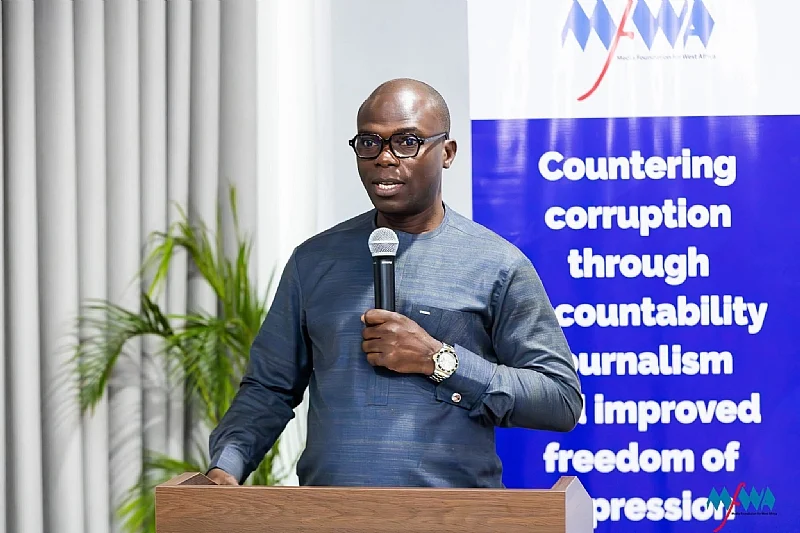
Mr. Sulemana Braimah, Executive Director of the Media Foundation for West Africa (MFWA), has stressed that exposing corruption, while essential, is only the first step toward achieving accountability.
According to him, a significant gap persists between investigative reporting and the imposition of actual sanctions.
“Exposure alone does not always lead to accountability,” he noted, emphasizing that without sustained effort and institutional commitment, even the most compelling revelations can fail to produce consequences.
Delivering the welcome remarks on “the Media and the Fight Against Corruption” in Ghana, on Thursday, March 26 in Accra, Mr. Braimah underscored that the fight against corruption requires resilience and determination to ensure that cases uncovered by journalists are pursued to their logical conclusion.
He pointed out that recent initiatives such as Operation Recover All Loot signal growing momentum in tackling corruption.
However, he cautioned that such efforts must be reinforced by strong, independent investigative journalism to be effective.
He further highlighted that the battle against corruption is not confined to courtrooms alone.
“Corruption is fought not only in the courtroom, but also in the newsroom,” he said, stressing the need for journalists who are courageous and steadfast in defending their work despite pressure or intimidation.
In Ghana today, he observed, investigative journalism remains one of the most critical tools in the collective push for accountability.
Yet, he warned of a troubling reality: corruption no longer hides in secrecy as it once did.
Instead, it often occurs in plain sight, banking on public inattention or an overstretched media landscape.
Mr. Braimah concluded by noting that corruption thrives not only in weak systems but also in silence. Breaking that silence, he implied, requires a coordinated effort where journalists, institutions, and citizens alike remain vigilant and committed to demanding transparency and justice.
By Sampson Kumah Ifeetwube Elvis
About The Author
