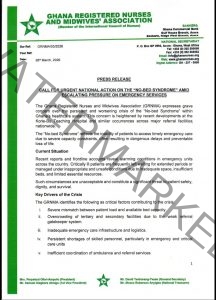
The Ghana Registered Nurses and Midwives Association (GRNMA) expresses grave concern over the persistent and worsening “No-Bed Syndrome” in Ghana’s healthcare system.
Recent developments at Korle-Bu Teaching Hospital, alongside similar incidents in major referral facilities nationwide, underscore the urgency of this crisis.
According to the Association, the “No-Bed Syndrome” reflects a critical failure in emergency care delivery, where patients are unable to access timely treatment due to severe capacity constraints often resulting in dangerous delays and preventable deaths.
Current Situation
GRNMA indicated that recent reports and frontline accounts reveal alarming conditions in emergency units across the country.
Critically ill patients are frequently left waiting for extended periods or managed under unsafe and inappropriate conditions due to Inadequate space, Insufficient bed capacity, and Limited essential resources
These circumstances are unacceptable and pose a serious threat to patient safety, dignity, and survival.
Key Drivers of the Crisis
The GRNMA identifies the following as major contributors:
- A severe mismatch between patient demand and available bed capacity
- Overcrowding at tertiary and secondary facilities due to weak referral systems
- Inadequate emergency care infrastructure and logistics
- Persistent shortages of skilled personnel, especially in emergency and critical care
- Inefficient coordination of ambulance and referral services
Situational Overview
Available data confirm that the crisis is systemic and long-standing:
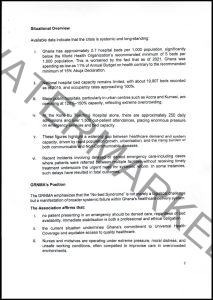
- Ghana has approximately 0.7 hospital beds per 1,000 people, far below the World Health Organization’s recommended minimum of 5 per 1,000.
- Government health spending has remained around 11% of the national budget, below the 15% Abuja Declaration target.
iii. National hospital bed capacity stood at about 19,907 beds (2015), with occupancy rates nearing 100%.
- Major hospitals in Accra and Kumasi operate at 120%–150% capacity, reflecting extreme overcrowding.
- At Korle-Bu Teaching Hospital alone, there are roughly 250 daily admissions and over 1,500 outpatient visits, placing immense pressure on emergency services.
These figures highlight a widening gap between healthcare demand and system capacity, driven by population growth, urbanisation, and the rising burden of both communicable and non-communicable diseases.
Recent incidents—where patients were delayed, referred multiple times, or denied timely care—further demonstrate the human cost of this crisis, with some cases resulting in fatalities.
GRNMA’s Position
The GRNMA emphasizes that the “No-Bed Syndrome” is not merely a logistical issue but a manifestation of deeper systemic failures.
The Association affirms that:
- No patient presenting with an emergency should be denied care, regardless of bed availability. Immediate stabilisation is both a professional and ethical obligation.
- The current situation undermines Ghana’s commitment to Universal Health Coverage and equitable access to quality healthcare.
iii. Nurses and midwives are working under extreme pressure, facing moral distress and unsafe conditions while improvising care in overcrowded environments.
Recommendations
The GRNMA calls on the Government of Ghana, the Ministry of Health, and the Ghana Health Service to urgently:
- Declare the “No-Bed Syndrome” a national public health emergency
- Expand emergency and inpatient infrastructure, particularly in high-demand urban areas
- Implement a national real-time bed tracking and patient flow system
- Strengthen referral systems to optimise the use of primary and district-level facilities
- Increase recruitment, equitable distribution, and retention of nurses, midwives, and other health workers
- Invest in emergency medical services, including improved ambulance availability and coordination
- Enforce strict emergency care protocols to ensure no patient is turned away without stabilisation
- Ensure health facilities are adequately equipped with essential logistics
- Establish accountability mechanisms, including independent investigations into recent incidents
Conclusion
Ghana’s healthcare system cannot continue operating beyond safe capacity while patients suffer avoidable harm. The dignity of patients and the integrity of healthcare professionals must be upheld at all times.
The GRNMA calls on all stakeholders, policymakers, healthcare managers, professional bodies, civil society organisations, and the general public to recognise that the “No-Bed Syndrome” is a national emergency requiring urgent, coordinated, and sustained action.
By Sampson Kumah Ifeetwube Elvis
About The Author
