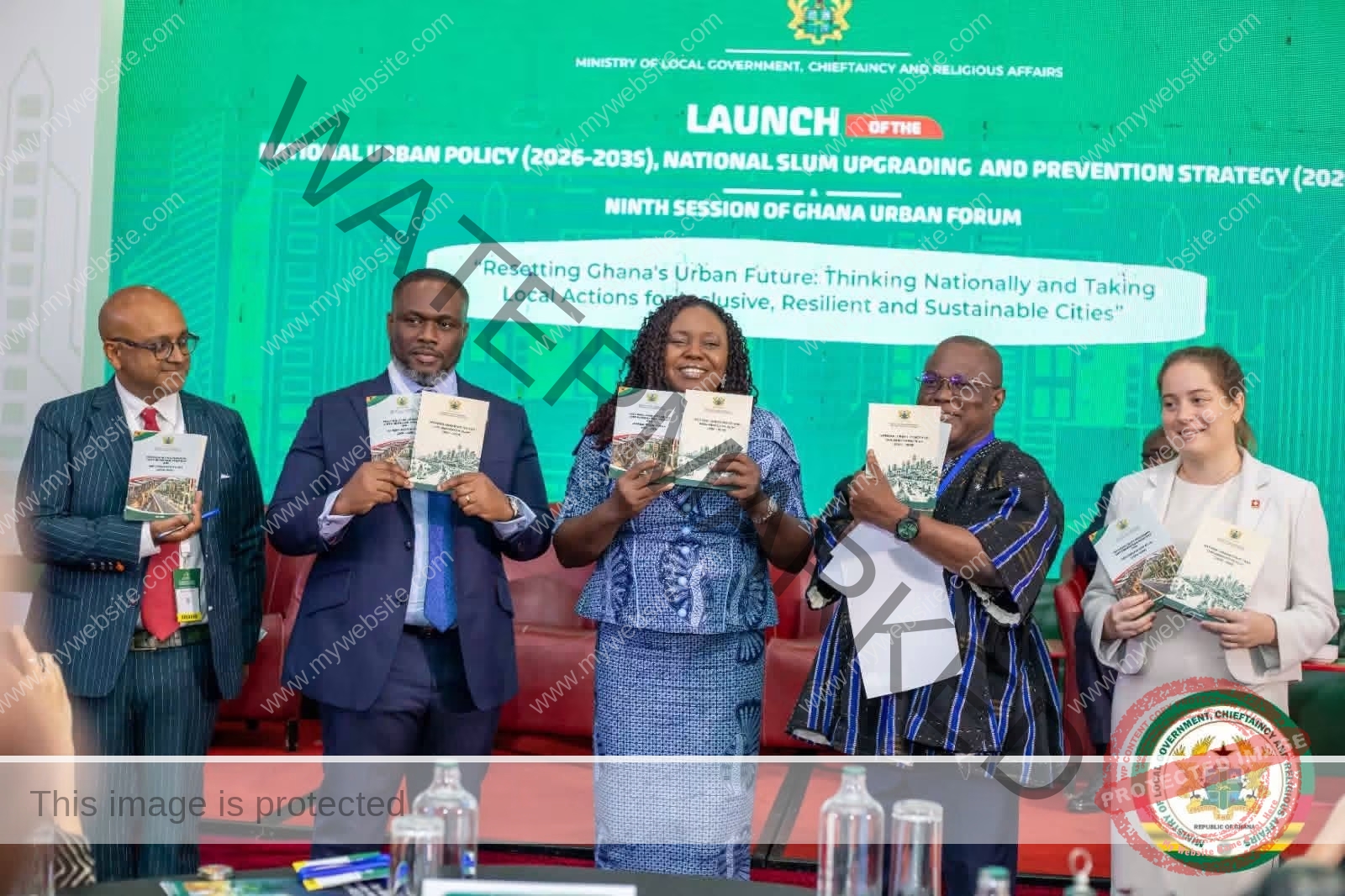
The Government of Ghana has launched a new National Urban Policy 2026-2035 and a National Slum Upgrading and Prevention Strategy 2026-2035 to drive inclusive, resilient and sustainable city development.
The two policy frameworks are aimed at addressing Ghana’s growing housing deficit, rapid slum expansion, congestion, flooding and infrastructure gaps.
The launch formed part of the 9th Ghana Urban Forum held under the theme “Resetting Ghana’s Urban Future: Thinking Nationally and Taking Local Actions for Inclusive, Resilient and Sustainable Cities.”
Speaking on behalf of the President, the Chairman of the National Development Planning Commission (NDPC), Dr. Nii Moi Thompson, said Ghana’s rapidly growing urban population makes effective urban planning critical to national development.
“The National Urban Policy and the National Slum Upgrading and Prevention Strategy represent our deliberate effort to reset our approach to urban development. They seek to promote inclusive, safe, resilient and sustainable cities that are economically vibrant, socially inclusive, environmentally sound and well-governed,” he said.
Dr. Thompson noted that Ghana’s urban population has increased from about four million in the 1980s to an estimated 20.4 million in 2026, with more than half of the population now living in towns and cities.
He said while urbanization has contributed to economic growth and poverty reduction, it has also led to unplanned settlements, congestion, flooding, poor sanitation, environmental degradation and a housing deficit projected to exceed two million units within the next decade.
He disclosed that a review of the 2012 National Urban Policy showed about 50 percent of its intended outcomes were achieved, but weak institutional coordination, inadequate financing and poor implementation limited impact. He expressed confidence that the new policy and strategy, aligned with the Sustainable Development Goals and other international commitments, will strengthen urban governance and improve service delivery.
Speaking on behalf of the Minister for Local Government, Chieftaincy and Religious Affairs, Ahmed Ibrahim, the Chief Director of the Ministry, Alhaji Amin Abdul-Rahaman, said the true measure of success would not be the quality of the documents, but effectiveness of implementation.
He said the 9th Ghana Urban Forum offers an opportunity for stakeholders to identify practical actions, strengthen partnerships and explore innovative financing to translate the policies into measurable outcomes.
He urged all Metropolitan, Municipal and District Assemblies to incorporate the new frameworks into their medium-term development plans and budgets.(MMDAs)
“The National Urban Policy seeks to promote sustainable and balanced urban growth, effective land use planning, climate resilience, improved infrastructure financing, affordable housing, urban safety and equitable access to essential services,” Alhaji Abdul-Rahaman stressed.
He emphasized that sustainable urban development requires strong collaboration among central and local government, traditional and religious leaders, the private sector, development partners and citizens.
He commended development partners including UN-Habitat, the World Bank, the European Union, UNICEF and the UK’s Foreign, Commonwealth and Development Office (FCDO) for supporting the development of the policies, and reaffirmed the Ministry’s commitment to coordinating implementation, monitoring and evaluation to guide investments and improve quality of life.
By Sampson Kumah Ifeetwube Elvis
About The Author
