
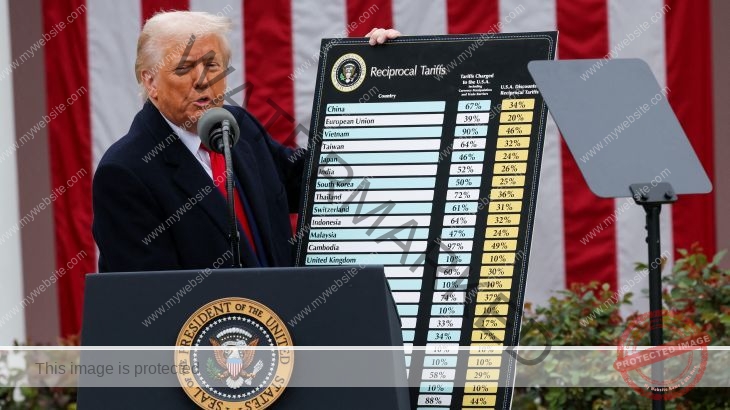
President Donald Trump announces a minimum 10% baseline tariff on all countries, including Ghana.
It will come into effect on 5 April.
Mr. Trump is now holding up a large chart showing a table titled “Reciprocal Tariffs”, which compares tariffs imposed by other countries on the US versus Washington’s levies.
It displays a 10% tariff on imports from the UK and 20% on EU imports.
“They charge us, we charge them.
How can anybody be upset?” he stated.
Among others, he singles out China and the European Union.
“They rip us off. It’s so sad to see. It’s so pathetic.”
“India,” he says, “very tough. Very, very tough,” he indicated.
President Donald Trump announced long-awaited reciprocal tariffs on America’s trading partners Wednesday.
The U.S. will impose tariffs at about half of what other countries do, with a minimum 10% tax. “We subsidize a lot of countries,” the president said.
“We’re not taking it anymore.”
It’s a day of tariffs that President Donald Trump vowed would “make America wealthy again.”
Mr. Trump on Wednesday announced sweeping reciprocal tariffs with the U.S.’ trading partners, to be set at about half of what other countries are charging America.
The U.S. will impose a 10% minimum tariff, too, Trump said in a speech from the White House Rose Garden.
“They do it to us, we do it to them,” Trump said during the event, saying it was America’s turn to prosper.
As the president delivered his speech, he held up a sign dense with charts, and shared specific examples: China taxes the United States 67%—a number Trump said accounted for currency manipulation—so the United States will tax China 34%.
The European Union’s total levies against the U.S. amount to 39%, so the U.S. will tax about 20%, Trump said. The U.S. will impose 25% on South Korea, 24% on Japan, and 32% on Taiwan.
“None of our companies are allowed to go into other countries,” he said. “I say that, friend and foe, and in many cases the friend is worse than the foe.”
He also reaffirmed that he would place 25% tariffs on foreign-made cars and parts, effective midnight.
“We subsidize a lot of countries,” the president said, blaming the trade deficit for the U.S.’ debt problem. “We’re not taking it anymore.”
Even before Trump’s Election Day victory, some economists warned the tariffs he promised on the campaign trail could be inflationary.
Ever since, his on-again, off-again tariffs and the threat of a global trade war not only pushed the S&P 500 into correction territory and tanked consumer sentiment, but set off recession calls from big banks and others in the finance world.
It’s kept the central bank in wait-and-see mode, too, when it comes to interest rates.
About The Author
