
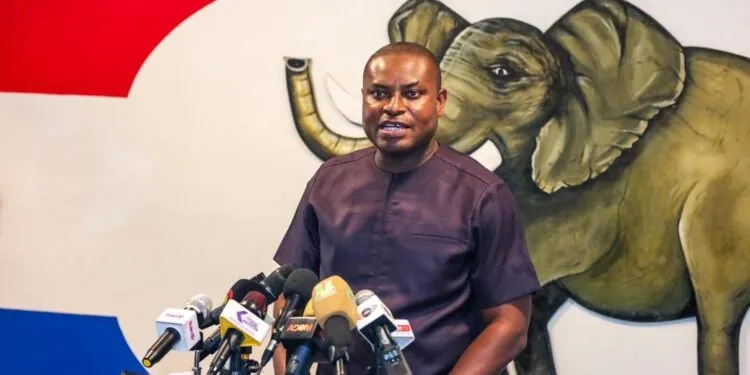
The New Patriotic Party (NPP) has sharply criticized the government’s handling of illegal mining, specifically galamsey, accusing the current administration of being complicit in the rise of illegal miners across Ghana.
During a news conference held at the party’s headquarters in Accra, Mr. Richard Ahiagbah, the NPP’s National Communication Director, lambasted the government’s failure to effectively combat the rampant destruction of Ghana’s forest reserves.
He warned that the lack of decisive action has only exacerbated the situation, leading to widespread environmental degradation and the further entrenchment of illegal mining activities.
The Growing Menace of Galamsey
Galamsey, an illegal mining practice that has ravaged forests and water bodies in Ghana, continues to be one of the most pressing environmental issues in the country.
Despite public outcry and numerous promises from the government to clamp down on illegal mining, the situation has only worsened over the years.
According to Ahiagbah, the government’s lack of commitment to addressing the issue has directly contributed to the widespread destruction of Ghana’s natural resources.
“The fight to curb galamsey is challenging, but the lack of commitment from this government has exacerbated the situation, leading to the devastation of many of our forests,” he stated.
This claim is particularly alarming as Ghana’s forests, which are vital to the nation’s ecosystem and economy, continue to be decimated at an alarming rate.
Allegations of Government Complicity
Mr. Ahiagbah did not hold back in his criticisms, accusing the ruling government of complicity in the expansion of illegal mining.
He alleged that members of the opposition National Democratic Congress (NDC) had actively campaigned in galamsey-prone areas during their time in power, promising to allow illegal miners to continue their activities.
He further claimed that individuals associated with the NDC had even recruited militants from neighboring Côte d’Ivoire and other regions to protect the illegal miners and their operations.
“Currently, mining has devastated 44 out of the 288 forest reserves in Ghana. At this rate, we risk losing all these forests to galamsey,” he emphasized.
The continued destruction of these vital forest reserves, he argued, threatens not only the country’s biodiversity but also the livelihoods of the millions of people who depend on these resources for their survival.
Mr. Ahiagbah’s accusations have raised concerns about the role of political affiliations in perpetuating illegal mining practices, as well as the lack of effective law enforcement to curb the activities of illegal miners.
The Cost of Inaction: Forest Reserves Under Siege
Ahiagbah specifically highlighted some of the country’s most threatened forest reserves, including the Offin Shelter Belt, Kyenkeynso and Gyaare in Akoasi, Tano Anwia in Aowin, Asenyano, and Jimira in the Nkawie District.
These areas have been overrun by illegal miners, who have reportedly attacked and injured members of the Forestry Commission’s rapid response team.
The damage caused by galamsey is not limited to the environment alone.
These illegal activities have led to violent clashes between miners and forestry officials, making it clear that illegal mining operations are often heavily armed and protected.
As these miners continue to ravage Ghana’s forests, the Forestry Commission’s efforts to combat galamsey have become increasingly dangerous and, in some cases, deadly.
A Call for Legislative Action
Mr. Ahiagbah also turned his focus to the legislative framework surrounding mining activities in Ghana, particularly the controversial Legislative Instrument (L.I.) 2462.
This instrument, which was supposed to regulate mining activities within forest reserves, has been a point of contention for many years.
According to Ahiagbah, President John Dramani Mahama had initially promised to revoke this law but later backtracked, opting instead to amend it to remove the President’s power to approve mining applications in forest reserves.
However, Mr. Ahiagbah argued that mere amendments would not suffice, given the scale of the destruction. “Amending the instrument would not be enough. What we need is a complete repeal of the law to ensure that mining in forest reserves is permanently banned,” he said.
His stance on the repeal of L.I. 2462 emphasizes the urgency of taking stronger measures to safeguard Ghana’s natural resources.
Mr. Ahiagbah’s call for a total ban on mining in forest reserves aims to curb the environmental devastation and protect Ghana’s forests from further destruction.
Public Awareness and Action: A Shared Responsibility
In response to the worsening situation, Mr. Ahiagbah urged Ghanaians to unite in the fight to protect the country’s environment.
He stressed that it is not enough for only a few individuals or organizations to be concerned; rather, the fight against galamsey must involve the collective effort of every Ghanaian.
“We cannot afford to remain indifferent. We urge all Ghanaians to join this fight to protect our environment and water bodies for ourselves and future generations,” he appealed.
Corruption and the Erosion of Accountability
In addition to his criticisms of the government’s handling of galamsey, Ahiagbah took issue with the government’s approach to corruption cases, particularly in the context of illegal mining. He condemned the Attorney-General and Minister of Justice, Dr. Dominic Ayine, for holding media briefings to discuss cases of corruption rather than allowing the judiciary to handle these matters in the courtroom.
Describing this as “persecution, not prosecution,” Ahiagbah accused the government of failing to pursue meaningful action against corruption. He pointed out that one of the government’s landmark decisions since taking office was the filing of “nolle prosequi,” a legal move that cleared all its members standing trial for corruption-related acts. This, according to Ahiagbah, demonstrates the government’s lack of political will to tackle corruption within its ranks.
As Richard Ahiagbah rightly points out, the solution to this crisis lies not only in stronger laws but also in a collective national effort to protect the environment.
Ghana’s forests and water bodies are in peril, and the time for meaningful, decisive action is now.
About The Author
