
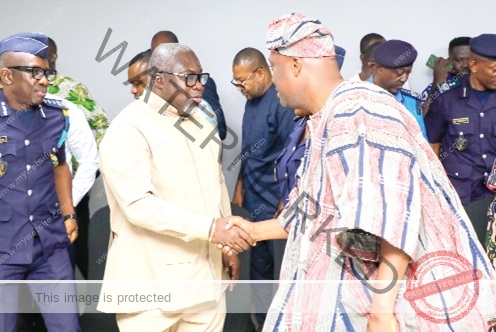
From February 1, 2026, the Customs Division of the Ghana Revenue Authority (GRA) will begin implementing an artificial intelligence (AI)-powered system to enhance import clearance at the country’s entry points, starting with the Tema Port.
The rollout of the AI-powered Publican Trade Solution is expected to significantly improve speed, efficiency and transparency in cargo processing, while boosting customs revenue by an estimated 40 to 45 per cent.
The system is also designed to address long-standing abuses associated with the use of import declaration forms (IDFs).
According to information contained in the 2026 Budget, between April 2020 and August 2025, more than 525,000 IDF transactions valued at about US$83 billion were processed through the Integrated Customs Management System (ICUMS).
However, only 10,440 of these transactions were linked to actual imports. During the same period, an estimated US$31 billion was transferred abroad without corresponding goods entering the country, while under-declared imports valued at approximately GH¢76 billion resulted in potential revenue losses of about GH¢11 billion to the state.
To address these gaps, the new AI-driven system will integrate customs and international trade data, enabling real-time analysis to support valuation, risk profiling and decision-making by customs officers.
It is expected to detect under-valuation, misclassification and other trade malpractices without imposing additional costs on importers, while facilitating legitimate trade and safeguarding government revenue.
The GRA has emphasised that the implementation of the system will not lead to higher costs for importers.
Cross-border trade reforms
Engaging the media in Accra last Friday, the Deputy Minister of Finance, Mr Thomas Nyarko Ampem, said the introduction of ICUMS in June 2020 was aimed at harmonising cross-border trade processes, reducing transaction costs and improving domestic revenue mobilisation.
While acknowledging that ICUMS had enhanced trade facilitation and operational efficiency, he noted that persistent challenges—such as undervaluation, misclassification, smuggling and falsification of trade data—continued to undermine effective customs controls.
“These discrepancies underscore the urgent need for an advanced, technology-driven inspection and analytics framework to strengthen compliance and close revenue leakages at the ports,” Mr Ampem said.
Modernising customs administration
He explained that government approval for the AI-powered trade data analytics system was part of broader efforts to modernise customs administration and enhance revenue mobilisation.
“This system will inspect every shipment document in real time, cross-check declarations with reliable global data sources, and flag high-risk or fraudulent transactions within minutes,” the Deputy Minister stated.
Mr Ampem assured importers and freight forwarders that the technology would not delay cargo clearance or impose additional costs on compliant businesses.
“Those who comply fully have nothing to fear, but from February, all importers must be prepared to pay the accurate duties on what they bring into the country,” he added.
A decisive shift in compliance
The Commissioner-General of the GRA, Mr Anthony Kwasi Sarpong, described the introduction of the AI-powered system as a decisive shift in the authority’s approach to revenue assurance and customs compliance.
He said persistent gaps under the ICUMS regime—particularly in valuation, classification and data integrity—had made it necessary to adopt a more intelligent and predictive system to support officers beyond manual checks.
“Customs operations today are driven by data, and if the data is distorted, then the outcomes will also be distorted,” Mr Sarpong noted.
He explained that the new platform would give customs officers instant access to credible international trade benchmarks, allowing them to verify declarations with greater accuracy and confidence.
“This platform does not replace our officers; it strengthens them by providing real-time intelligence that would otherwise take weeks or months to uncover,” he said.
Mr Sarpong added that early results from the pilot phase had already demonstrated the system’s effectiveness, with additional revenue recovered from a small sample of transactions highlighting the scale of potential leakages.
Commitment to fair trade
The Commissioner-General reaffirmed the GRA’s commitment to ensuring that the deployment of the technology is transparent, fair and business-friendly, particularly for compliant importers.
“If you are doing the right thing, this system will actually make your clearance faster and more predictable,” he said.
He stressed that the Authority would continue engaging stakeholders ahead of full implementation to address concerns and build trust.
“Our goal is not to punish trade, but to protect the integrity of Ghana’s revenue system while facilitating legitimate commerce,” Mr Sarpong added.
By Sampson Kumah Ifeetwube Elvis
About The Author
