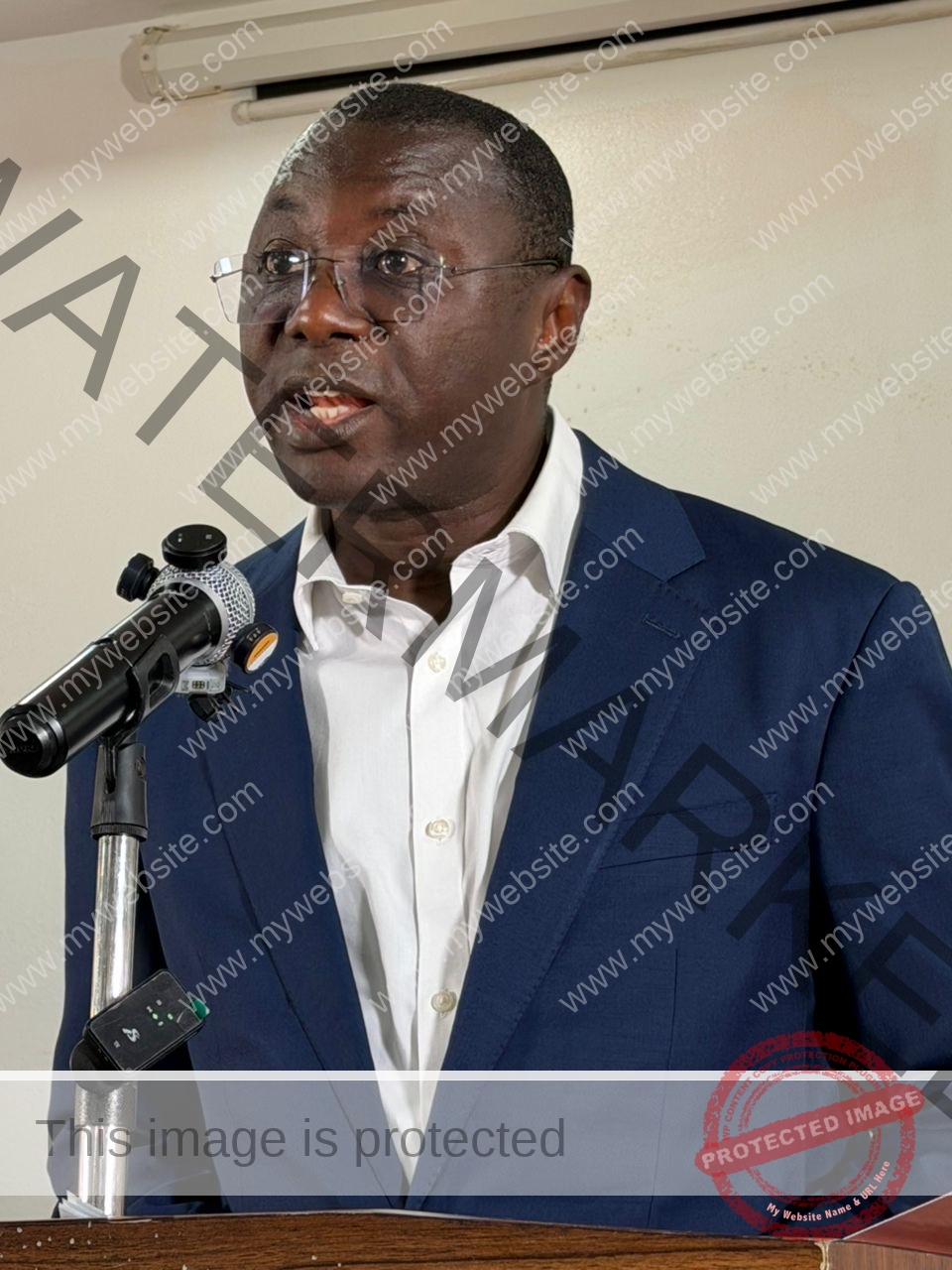
Former Finance Minister, Dr. Mohammed Amin Adam, says Ghana lost more than US$1.7 billion, about GH¢22 billion, through its gold purchase programme in 2025, citing data from the International Monetary Fund (IMF).
According to him, the loss represents about 1.5% of the country’s Gross Domestic Product for the year and was contained in IMF Country Report 2026/212, the audited 2025 accounts of the Bank of Ghana and GoldBod.
Addressing a press conference at the NPP headquarters in Accra, Dr. Amin Adam said the New Patriotic Party (NPP) had reviewed the IMF report, the Bank of Ghana’s published data, and the Ghana Gold Board Act, and is demanding full accountability.
“The IMF did not manufacture these figures. They come from the Bank of Ghana, the Ministry of Finance and other government agencies. IMF reports are submitted to the authorities to confirm every line and every number before publication,” he said.

Three Institutions, Three Different Numbers
Dr. Amin Adam said three different figures have been reported by three institutions involved in the same gold transaction chain – GH¢22 billion by the IMF, GH¢9.05 billion loss by the Bank of Ghana, and GH¢5.45 billion surplus by GoldBod – creating confusion.
He explained that the difference between the IMF and Bank of Ghana figures is explained by two items:
– GH¢5 billion transferred from the Consolidated Fund, described by the Finance Minister as a recapitalization bond – effectively a loan to be repaid by taxpayers.
– GH¢7.99 billion in paper gains booked as income when the Bank sold 22.24 tonnes of reserve gold in October 2025 for US$3.02 billion. The gains were unrealised gains on gold bought in 2023 and 2024 under the Akufo-Addo government.
“Subtract both from GH¢22 billion and about GH¢9.01 billion remains, almost exactly the Bank’s reported GH¢9.05 billion loss. The IMF was not wrong. The Bank of Ghana simply never explained to Ghanaians how a real cost of GH¢22 billion came to be presented as a loss of GH¢9.05 billion,” he stated.
GoldBod’s Surplus Is Not A Surplus
The former Finance Minister challenged GoldBod’s reported GH¢5.45 billion surplus, saying 81.7% of it was a government capital injection.
“Of GoldBod’s reported GH¢5.45 billion surplus, GH¢4.54 billion, or 81.7%, was a government capital injection credited to its books on 30 December 2025, one day before the financial year closed,” he said.
He argued that under standard accounting rules, money put in by an owner is capital, not revenue, and that GoldBod’s own statements describe it as revolving trade capital.
“Of the remaining GH¢909.9 million, about GH¢827 million was fee income, mostly service charges paid to GoldBod by the Bank of Ghana for the very same operations. How does a gold buying operator record a surplus while the institution whose funds it is using records a loss?” he quizzed.
He further claimed that without a GH¢7.99 billion accounting reclassification, the Bank of Ghana’s solvency would flip from positive GH¢5.50 billion to negative GH¢2.49 billion, with total equity worsening from negative GH¢61.32 billion to negative GH¢96.28 billion.
Why The Programme Kept Losing Money
According to Dr. Amin Adam, three built-in costs made the system lose money on every trade:
– Different exchange rates: The Bank advanced cedis at the official interbank rate while GoldBod paid miners at the higher forex bureau rate.
– A discount to foreign buyers: In October 2025, Ghana sold gold at US$3,919 an ounce against a world average of US$4,054 – a 3.3% discount worth roughly US$450 million a year.
– Handling fees: A 0.5% service fee and 0.258% assay fee on the full value of every trade.
“The IMF puts these combined costs at 14.5% of the programme’s value in 2025, falling to 5.4% under the new arrangement, an admission that Ghana was running a system nearly three times more expensive than it needed to be,” he said.
He lamented that the loss occurred despite a 62.9% rise in gold prices in 2025, from an average of US$2,395 to US$3,441 an ounce – one of the strongest gold markets in 50 years.
“Ghana bought gold, sold gold, and lost money, in the best gold market in fifty years,” he stated.
Did It Build Reserves?
Dr. Amin Adam disputed government’s claim that the programme built reserves, saying Bank of Ghana data shows gold contributed only US$60.9 million, just 1.3%, of the US$4,716 million increase in reserves. He said actual gold holdings fell from 30.5 tonnes to 18.6 tonnes – a 39% decline.
“Reserve growth came instead from remittances of US$7.79 billion, cocoa earnings of US$3.86 billion, crude oil exports of US$2.62 billion and foreign direct investment of US$2.61 billion,” he said.
He added that in 2025, GoldBod exported about 103.8 tonnes of small-scale gold, with 98.8% going to just two destinations – Dubai and India – without disclosure of buyers or commercial terms.
He also cited the scrapping of the 1.5% withholding tax on unprocessed small-scale gold, worth about US$150 million a year, taking the total cost close to US$1.9 billion.

Was The Law Followed?
The NPP alleged that GoldBod’s fees were charged without the required Legislative Instrument, with Parliament’s Subsidiary Legislation Committee Chair confirming in October 2025 that the fee structure had never been submitted.
He said the quarterly reports required under Section 42 of the Ghana Gold Board Act have never been produced, and that on 27 July 2026, the IMF Executive Board granted Ghana a waiver for breaching the December 2025 limit on central bank lending to government.
What NPP Is Demanding
While welcoming the Bank’s decision to stop pre-financing gold purchases from 1 July 2026 and an ongoing independent audit, Dr. Amin Adam said correction is not accountability.
The party is demanding:
– A signed reconciliation from the Bank of Ghana, GoldBod and the Finance Ministry showing how the GH¢22bn, GH¢9.05bn and GH¢5.45bn figures connect
– Names of foreign buyers, discounts and commercial terms
– The agreement authorising roughly GH¢133 billion in central bank money routed through GoldBod, and the LI authorising fees
– A restated set of GoldBod’s 2025 accounts removing the GH¢4.54bn capital injection from revenue
– Removal of the Governor of the Bank of Ghana from GoldBod’s board
The party also supports calls for a full parliamentary inquiry, noting that the Speaker has already admitted a motion for one.
“GH¢22 billion of this country’s money was lost through a system that was approved, only partly disclosed across two different sets of accounts, and never fully explained. It took the IMF, reporting from Washington, to tell Ghanaians what their own central bank had spent,” Dr. Amin Adam concluded.
By Sampson Kumah Ifeetwube Elvis
About The Author
